


- Enquête KANTAR TNS 2016 (14073 foyers français interrogés fin 2016)
- Laflamme DP et al. Discrepancy between use of lean body mass or nitrogen balance to determine protein requirements for adult cats. JFMS 2013 – 0(0) 1 – 7;
- Hughes R et al. Protein degradation in the large intestine: relevance to colorectal cancer. Current Issues in Intestinal Microbiology 2000 – 1, 51 – 58 ;
- MacFarlane GT et al. The colonic flora, fermentation, and large bowel digestive function. In: S. F. Phillips, J. H. Pemberton, R. G. Shorter(eds), The Large intestine: Physiology, Pathophysiology, and Disease. Raven Press, New York, 1991, pp. 51 – 92 ;
- Carlo Pinna et al. In vitro influence of dietary protein and fructooligosaccharides on metabolism of canine fecal microbiota. BMC Veterinary Research(2016) 12 : 53 ;
- Ross SJ, et al. Clinical evaluation of effects of dietary modification in cats with spontaneous chronic renal failure. JAVMA, Vol 229, No. 6, September 15, 2006 ; 949 – 57 ;
- Jacob F et al. Clinical evaluation of dietary modification for treatment of spontaneous chronic renal failure in dogs. JAVMA 2002 Apr 15 ; 220(8) : 1163 – 70 ;
- Elliott et al, Survival of cats with naturally occurring chronic renal failure: effect of dietary management. J Small Anim Pract 2000 ; 41 : 235 – 41.
- King JN, Tasker S, Gunn-Moore DA. Prognostic factors in cats with chronic kidney disease. J Vet Intern Med 2007 ; 21 : 906 – 16 ;
- Middelbos IS et al. Evaluation of fermentable oligosaccharides in diets fed to dogs in comparison to fiber standards. J Anim Sci.


Smakelijke tips
multiReplace" id="64" data-gr-id="64">2007 ; 85 : 3033 – 30344.
- Leib MS. Treatment of chronic idiopathic large-bowel diarrhea in dogs with a highly digestible diet and soluble fiber:
a retrospective review of 37 cases. J Vet Intern Med. 2000 ; 14 : 27 – 32. - Freiche V et al. Uncontrolled study assessing the impact of a psyllium-enriched extruded dry diet on faecal consistency in cats with constipation. J Feline Med Surg. 2011 ; 13 : 903 – 911.
- Kienzle E. Carbohydrate metabolism of the cat – 2. Digestion of starch. J Anim Physiol Anim Nutr 1993 ; 69 : 102 – 114 ;
- De Oliveira L et al. Effects of six carbohydrate sources on cat diet digestibility and postprandial glucose and insulin response. J Anim Sci 2008 ; 86 : 2237 – 2246 ;
- Axelsson E et al. The genomic signature of dog domestication reveals adaptation to a starch-rich diet. Nature 2013 ; 495 : 360 – 364 ;
- Buffington C. Dry foods and risk of disease in cats. Can Vet J 2008 ; 49 : 561 – 563 ;
- Backus RC, Cave NJ and Keisler DH. Gonadectomy and high dietary fat but not high dietary carbohydrate induce gains in body weight and fat of domestic cats.
Br J Nutr 2007 ; 98 : 641 – 50 ; - Slingerland LI, Fazilova VV, Plantinga EA, et al. Indoor confinement and physical inactivity rather than the proportion of dry food are risk factors in the development of feline type 2 diabetes mellitus. Vet J 2009 ; 179 : 247 – 253 ;
- Pimente D, Pimentel M, Sustainability of meat-based and plant-based diets and the environment. Am J Clin Nutr 2003 ; 78(suppl) : 660S – 3S ;

Gerelateerde producten
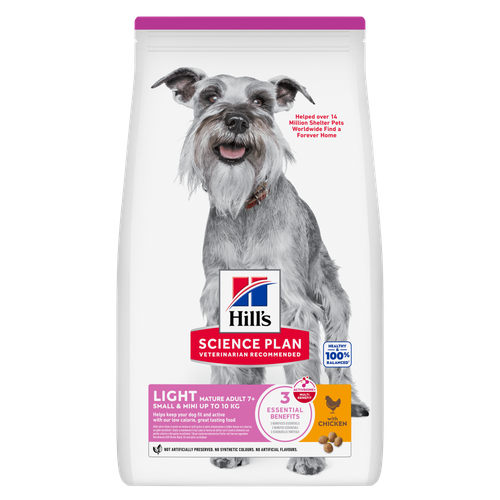
Light Small & Mini Mature Adult Hondenvoer met Kip
Hill's Science Plan Light Small & Mini Mature Adult Hondenvoer met Kip is een compleet dierenvoer, speciaal samengesteld met ActivBiome+ Multi-Benefit technologie. Ons heerlijke voer met weinig calorieën helpt je hond fit en actief te houden.Precieze voeding voor minder actieve oudere volwassen honden van een klein ras die weinig calorieën nodig hebben om een gezond gewicht en een gezonde levensstijl te behouden.
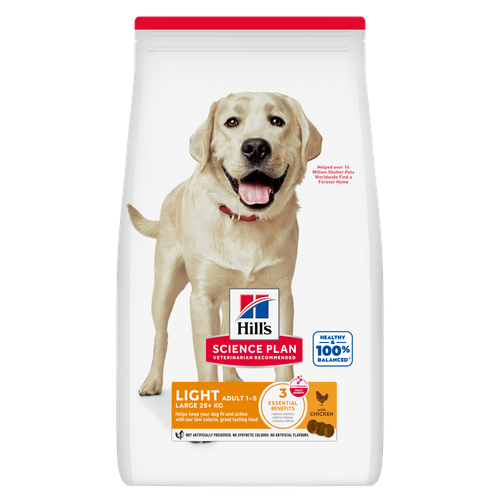
Light Large Breed Adult Hondenvoer met Kip
Hill's Science Plan Light Large Breed Adult Hondenvoer met Kip is een compleet dierenvoer, speciaal samengesteld met ActivBiome+ Multi-Benefit technologie. Ons heerlijke voer met weinig calorieën helpt je hond fit en actief te houden.Precieze voeding voor minder actieve volwassen honden van een groot ras die weinig calorieën nodig hebben om een gezond gewicht en een gezonde levensstijl te behouden.
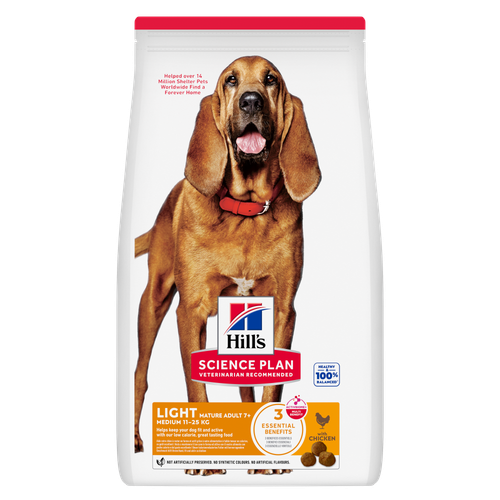
Light Medium Mature Adult Hondenvoer met Kip
Hill's Science Plan Light Mature Adult Medium Hondenvoer met Kip is een compleet dierenvoer, speciaal samengesteld met ActivBiome+ Multi-Benefit technologie. Ons heerlijke voer met weinig calorieën helpt je hond fit en actief te houden.Precieze voeding voor minder actieve oudere volwassen honden die weinig calorieën nodig hebben om een gezond gewicht en een gezonde levensstijl te behouden.
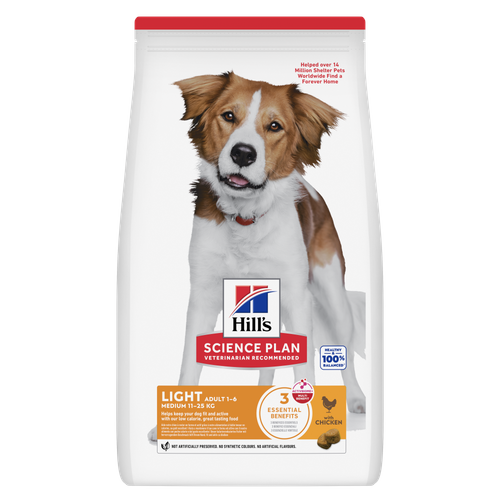
Light Medium Adult Hondenvoer met Kip
Hill's Science Plan Light Medium Adult Hondenvoer met Kip is een compleet dierenvoer, speciaal samengesteld met ActivBiome+ Multi-Benefit technologie. Ons heerlijke voer met weinig calorieën helpt je hond fit en actief te houden.Precieze voeding voor minder actieve volwassen honden van een middelgroot ras die weinig calorieën nodig hebben om een gezond gewicht en een gezonde levensstijl te behouden.
Gerelateerde artikelen

Compare Your Pet Food's Calories to Other Brands
Compare popular pet food brands against Hill

Water
Water is the most important nutrient of all and essential for life. Animals can lose almost all their fat and half their protein and still survive, but if they lose 15% of their water, it will mean death.

Eiwitten
To make a protein, amino acids are linked together in a long chain. The chain is then bundled into to a three-dimensional structure, like a tangled ball of yarn. Although there are hundreds of different amino acids, only 21 are used in animal proteins.
Antioxidants in Pet Food: Why They're Important to Your Pet's Diet
Learn more about free radicals and how antioxidants help provide some protection against free radicals and how Hills pet foods makes a difference.

Zet uw huisdier op dieet zonder dat hij het weet
Onze caloriearme formule helpt u het gewicht van uw huisdier onder controle te houden. Het zit boordevol hoogwaardige eiwitten voor de opbouw van soepele spieren en is gemaakt met doelgerichte ingrediënten voor een smakelijke, voedzame maaltijd. Klinisch bewezen antioxidanten, vitamine C+E, dragen bij aan een gezond immuunsysteem.
Zet uw huisdier op dieet zonder dat hij het weet
Onze caloriearme formule helpt u het gewicht van uw huisdier onder controle te houden. Het zit boordevol hoogwaardige eiwitten voor de opbouw van soepele spieren en is gemaakt met doelgerichte ingrediënten voor een smakelijke, voedzame maaltijd. Klinisch bewezen antioxidanten, vitamine C+E, dragen bij aan een gezond immuunsysteem.